


Welcome! I’m Meg — founder of Jean Genie Vintage, curated online vintage denim destination — built on over a decade of sourcing, studying, and wearing vintage Levi’s, with clear-eyed advice on fit, quality, and value.
Let’s get down to business…
Have you ever tried to buy a pair vintage jeans and thought,
“This tag size is not right!!” Or “I’m a 28, but I can’t get these over my ass!?” or “WTF?!”
You’re not wrong — and you’re definitely not alone.
Because here’s the truth that isn’t explained clearly or often enough:
Modern tag size, vintage tag size, and the ACTUAL size of vintage denim are not equal. Sometimes not even close. Do we need to say it louder for the people in the back? THE TAG SIZE IS THE ULTIMATE GASLIGHTER!
And the confusion often stops so many people from experiencing truly great vintage denim. So… I’m here to help you crack the code.
First things first: You must immediately detach from what size you think you are!
Modern sizing is also known as vanity sizing. This practice of manipulating clothing labels with smaller sizes than their actual size originated in the 1970s and 80s to boost sales by making shoppers feel better about their bodies — ultimately rendering the tag size meaningless. As average body sizes increased and tag sizes continued to shrink, sales kept growing. Retail Ego Engineering 101.
So when someone tells me they wear a 26 in modern denim, that gives me almost zero useful information. Also, so many pairs of modern jeans have stretch, which makes things even more challenging to convert to vintage sizes.
With vintage jeans, I go solely off what are called flat lay measurements. And from this, you’ll get your actual size — which is simply (as simple as it can get) outlined in my fit guide.
Let Me Show You Just How confusing it can be…
I wear a modern size 26 in most brands of jeans.
But when I measure using my fit guide:
My waist measures 14”
Double that → and it equals to what I call an actual 28
Most of my vintage Levi’s tags?
Size 30 or 31.
See? Consistently inconsistent. Welcome to vintage denim land — where the tags lie and the ego is often shrinking to fit. Measure twice, buy once. Don’t forget your tape measure. (I personally carry one in my bag at all time.)

So How Do You Actually Get the Right Fit?
Step 1: Start With Jeans You Already Love — and that you want to somewhat replicate the fit.
NON-NEGOTIABLES:
They must be 100% cotton (non-stretch, I mean not even 1% stretch)
Newly washed and dried (not stretched out from wear). We want to measure on a pair of jeans when they are at the smallest they can possibly be — because that’s what I do when I measure for those that go into my shop, and all 100% cotton denim jeans will loosen with wear.
Step 2. Shake them out and lay them flat — just as they want to lay. Don’t match up the front and back of the waistband.
Step 3. Measure 1 - 5. Write it down. Put them in your phone notes. Tattoo them on your arm.
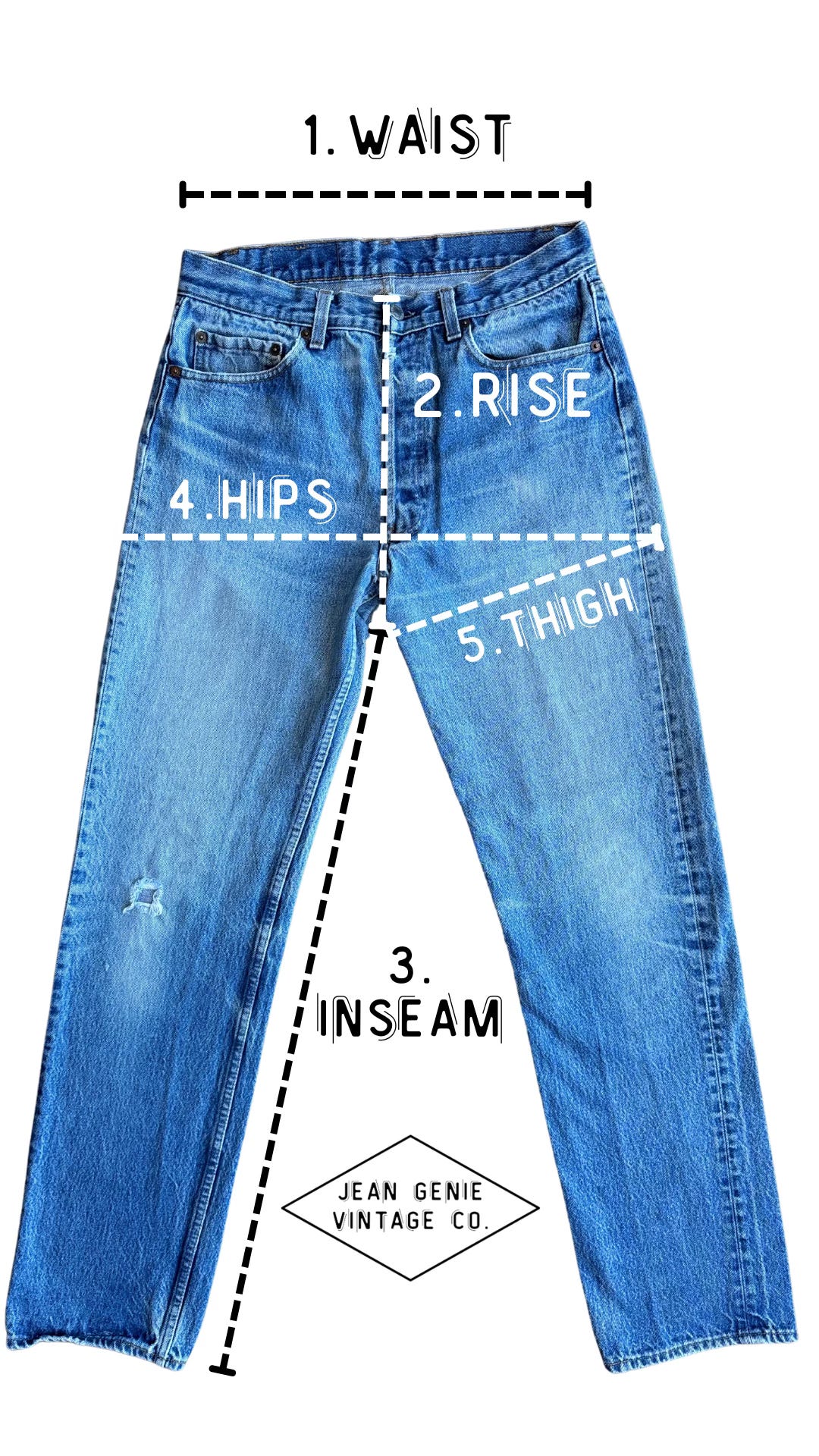
These are now your fit blueprint.
How to Shop my Website Once You Know Your Numbers
In my shop, I categorize my inventory in sections by actual size.
Here’s the rule:
👉🏽 Double your flat-lay waist measurement. That’s your section.
Example:
Flat lay waist = 14”
Double it = 28
You’ll shop in the 28/29 section
Note: I always size down. So if you’re a 14.25” flat lay waist, I’d call that a 28
From there, you’ll match your measurements to the ones listed in each product description.
Pro tip: to ensure the best fit in your bum/hips, that will be #4 from the diagram. the hips — in my shop, they are shown in the listing photos. This is especially important with styles like 505s and 517s that can run slimmer through the seat and thigh, than say a 501.
Length can be altered, so don’t let that deter you from buying a pair that will fit you well everywhere else.
Tiny print: Keep in mind, if you’re using these measurements to purchase from another seller, they may not be using the measurements exactly like I do. So you’ll always want to ask how they measure.
Once You Know Your Numbers…
Everything changes.
You’ll:
Shop faster & with more confidence
Avoid disappointment
Understand your body in denim
You can use these measurements for other types of pants too! Find a pair of vintage Ralph Lauren trousers — you already know what you need to see if they’re a fit.
This is a lot of information to digest.
I know that. Maybe read it twice.
But I promise you — this method works. I didn’t create it. It’s been used for centuries by tailors near and far.
Vintage denim isn’t confusing once you remove the illusion of sizing and replace it with real measurements. And when you slip into a pair that fits exactly how you hoped it would — it may change your opinion on jeans, and you’ll never look at modern jeans the same way again. Trust me.
Forever blue jeans,
xo, Meg