


Welcome! I’m Meg — founder of Jean Genie Vintage, your curated online vintage denim destination — built on over a decade of sourcing, studying, and wearing vintage Levi’s, with clear-eyed advice on fit, quality, and value.
Let’s get down to business…
Everyone wants the perfect Levi’s butt. We’ve all seen it — and we all chase it.
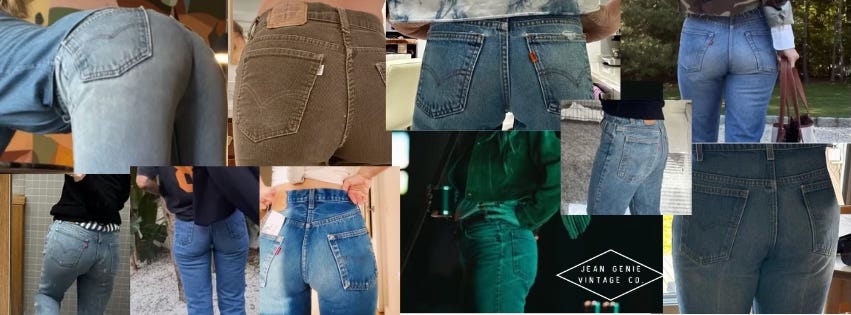
The lift. The shape. The way a pair of jeans somehow makes everything look exactly as it should — effortless, balanced, just structured enough. The kind of fit that makes people ask me (Meg) day in and day out, “Wait… what style are those?”
We’ve all been trained to shop denim by one number — the waist. “I’m a size 26.” “My flat lay waist is a 14.5”. “Looking for that perfect 33.” Clean, simple, & contradictory.
Here’s the part no one tells you:
It’s not only the waist.
It’s almost more importantly — the hips. Specifically the flay lay measurement taken from hip to hip, just below the fly.
So what actually makes the magic happen?
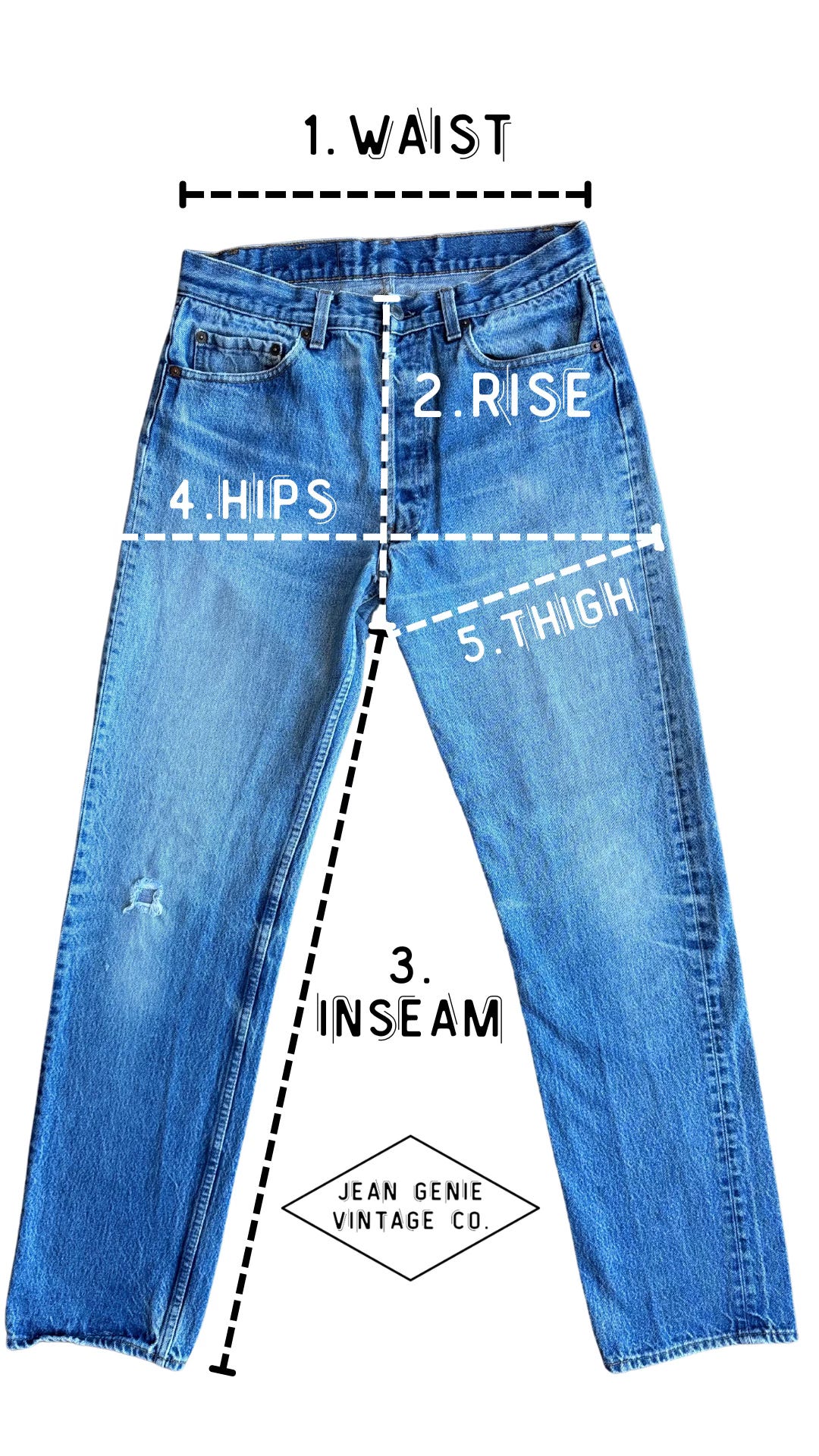
If you’re working from flat lay measurements (which you should be, especially when buying vintage), the most important number — the one almost no one talks about — is the hip measurement. (see #4 below from my fit guide)
This is the make-or-break if you want the perfect fit in the tush.
So, let’s break it down.
When you measure jeans flat:
• The waist tells you how they’ll close.
• The hip measurement (#4 below) will tell you how they’ll shape you.
Too small in the hips?
If you CAN get them over your hips, you’ll likely get pulling across the front, flattening in the back.
Too big?
No structure. No lift. Just loose fabric. Bunching or hanging in an unflattering way,
Just right?
That’s your Levi’s butt. Goldilocks glutes.
Why this matters even more with vintage
Vintage Levi’s are 100% cotton — no manufactured stretch. There’s no safety net. No Lycra coming in to help get them over your tush — or save a bad fit.
Which means every measurement counts — but the hips count most if you want them to flatter your behind.
And here’s where it gets tricky (and why I’ll show you in the photos — in a second):
Two pairs can have identical waists and wildly different hip measurements.
That’s not an anomaly—it’s the norm.
Different years, different factories, different cuts… all hiding behind the same tagged size or waist measurement. Not to mention whoever the previous owner was had a unique body type (to them), which altered the shape over the life they shared. So even if two pairs are the same tag size, from the same year, from the same factory — they will not be the same measurements.
100% one-of-one and that’s the beauty. Total uniqueness.
TIPS WHEN IT COMES TO THE DIFFERENT STYLE NUMBERS
501: Straight leg. Button Fly.
Key points:
Anti-fit. Back panel cut wider than front panel — which gives that bum hug and lift.
This particular style has a smaller waist : bigger hip ratio — generally speaking. Which is why it’s the best choice for our curvy figures or muscular booties.
Pro tips for 501s and the evolution of how they were cut over the decades:
• 501s from the 70s up until about 1994 were cut more narrow/slim in the hips. 1990-1994 especially are great years for those who are very straight in body type.
• 501s from 1995/96-2002 were cut more relaxed in the hip/bum. These are the target years for the more hourglass or full-figured folks.
See below. Two pairs of USA 501s with the flat lay waist size of 15” or what I call an “actual 30”. But as you can see the bottom pair has a wider hip measurement.
505 and 517 and 646: All zip fly. 505: straight leg. 517: bootcut. 646: Flare/Baby Bell
Key points:
All three of these styles, although the leg looks differently from the knee down, have very similar top blocks (the waist down to the upper thighs).
They all have equal front and back panels — giving a more tailored look.
But most importantly — as they pertain to the topic at hand — they are all cut more narrow in the hips (compared to a 501).
THESE styles are the ones you REALLY have to double check that hip measurement as it will ultimately be the deciding factor as to whether you can get them over your hips. (Remember 100% cotton, means no added lycra to help get over your humps.)
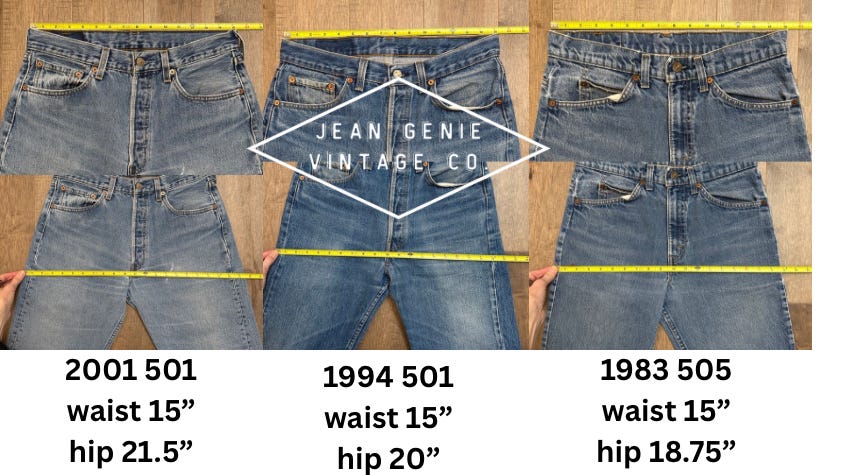
BELOW… Here we have 3 pairs of USA Made vintage Levi’s ALL with a flat lay waist of 15”. But as you can see, the hip measurements are all significantly different.
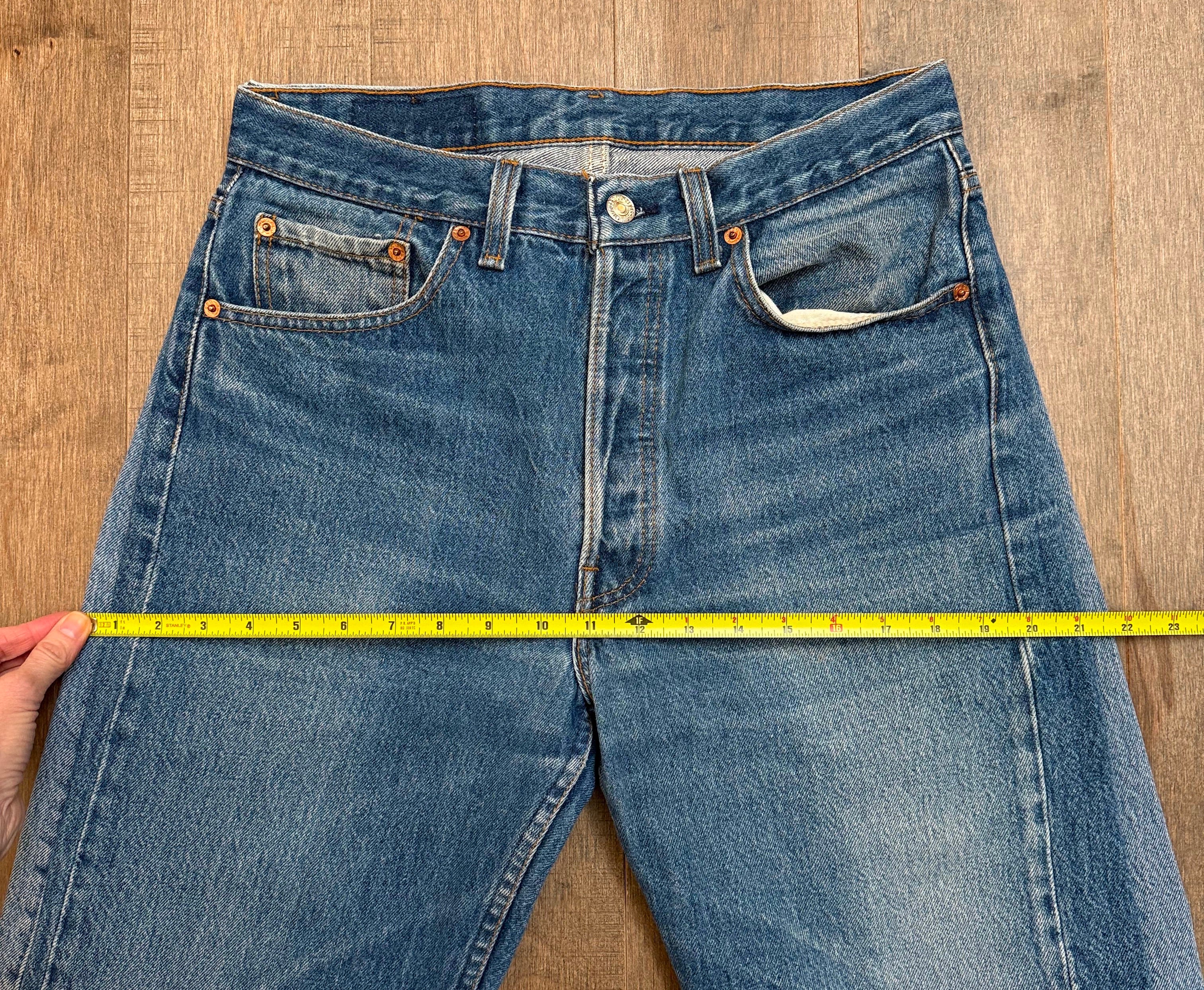
And you have to keep in mind, you double the hip measurement.
So… There is a 3” difference in the hips, between the 2001 and the 1994 501. And a 5.5” difference between the 2001 501 and the 1983 505. And all 3 have the same waist. That is significant. I rest my case.
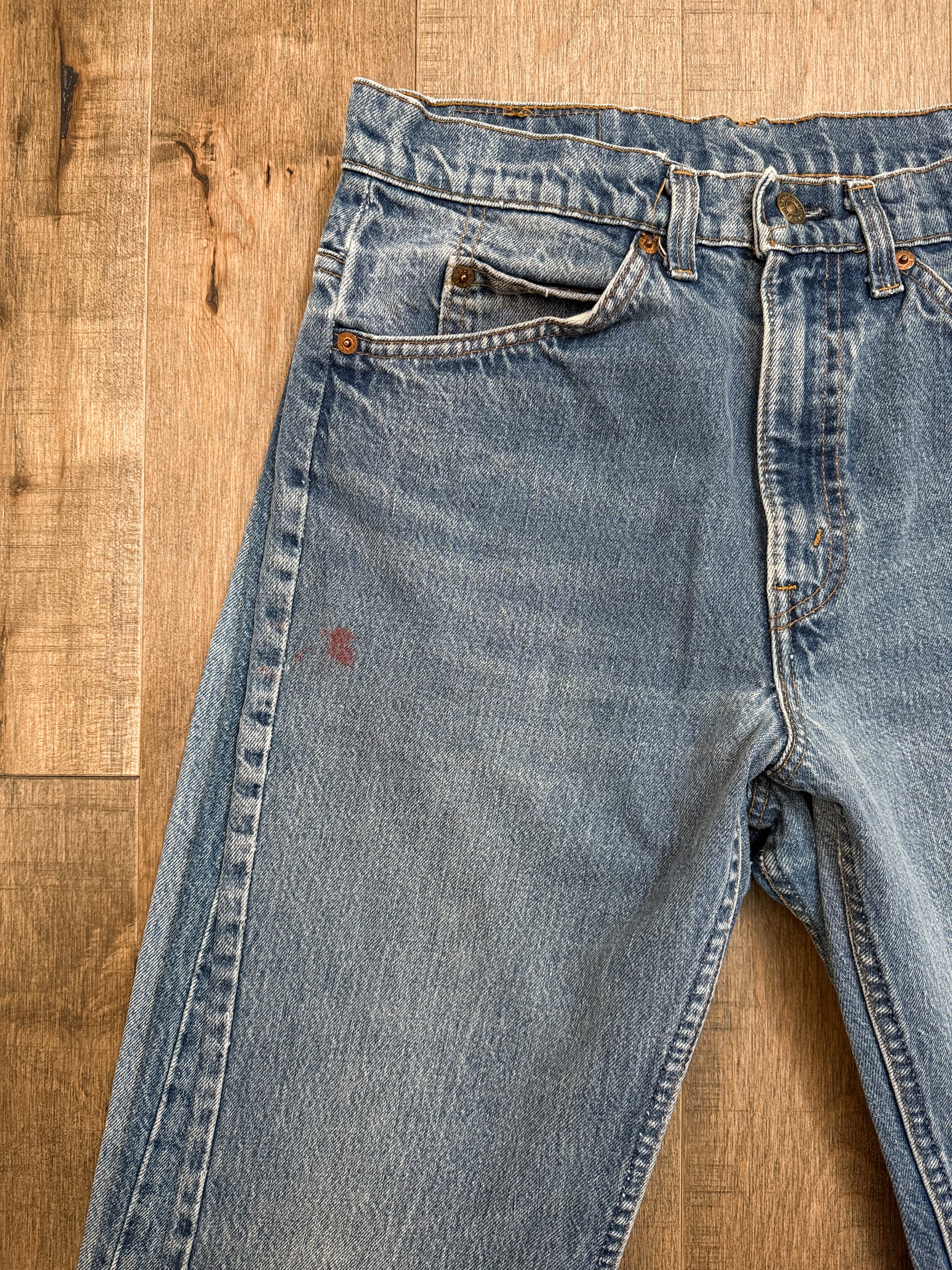
EXCEPTIONS FOR ALL STYLES: We must always reiterate that these jeans have had a previous life — and were lived in by a previous body type. They were stretched and molded to their body with years of wear. So there is no hard rules here, and ultimately you must go solely off the measurements that they have today. Two pairs of jeans — same year, same factory, same tag size — will almost certainly measure differently because they were worn by different bodies.
The takeaway (the only one you really need):
Stop buying jeans based on the waist alone.
Start looking at the hips. Sometimes you have to size up in the waist to accommodate of the hips so that you can get that perfect backside hug — and that potential waist gap that can result… well I call it “pizza room”. Others choose to have the waist nipped in.
This also means that you can shop in the size up, which maybe your ego has prevented you from doing previously.
I truly believe there’s a pair of jeans out there to flatter every rear — whether you’re curvy, straight, or carrying a little extra in places you once didn’t. And the best part? You don’t need to pay for custom fittings or major alterations to get there. Get your measurements down, and the right cut will do all the work for you.
Trust the hips. Thank me later.
Forever in blue jeans,
XO, Meg
LOOSE THREADS: You might as well pull…
If you want to know more about finding your perfect fit — read more about how to Detach from the Tag and stop letting your ego guide you in your sizing.
Still not sure how to tell vintage from used — I got you. Read this and stopped getting duped.
If you want to check out my constantly changing curation of true Made in USA Vintage Levi’s — check out my shop!
This is so informative. And smart!
Goldilocks glutes FTW