


Welcome! I’m Meg — founder of Jean Genie Vintage, curated online vintage denim destination — built on over a decade of sourcing, studying, and wearing vintage Levi’s, with clear-eyed advice on fit, quality, and value.
Let’s get down to business…
Vintage Levi’s are having a moment. Unfortunately, so are used jeans pretending to be vintage. And some with a very high (and undeserving & unwarranted) price tag.

Which raises the obvious question: HOW do you tell the difference between “old jeans” and the “real deal”?
I should know, I’ve sourced and sold thousands since starting Jean Genie Vintage.
Vintage is one of the most abused words on the internet these days.
Right up there with artisan, curated, and farm-to-table. Words that started with actual meaning — with a criteria — but now function mostly as very effective marketing.
And let’s be honest: vintage is the perfect buzzword. It sounds romantic. Sustainable. A little exclusive. The word that can make a pair of used jeans — with that two-horse tag and some epic fades — feel like you struck blue gold.
Scroll through any resale platform and suddenly everything is vintage: last year’s mall jeans, something someone found in the back of their closet, or a pair of Levi’s from 2014 that has simply… lived a solid (albeit somewhat short) life.
But here’s the thing:
Used is not always vintage. And vintage isn’t always used.
Say it again. Let it sink it.
And if you’re paying vintage prices — especially for Levi’s, you deserve to know what you’re getting.
After more than a decade obsessing over denim—and several years spent hunting down and selling thousands of pairs of true vintage Levi’s — I can tell you two simple ways to separate the real thing from the imposters.
*Note: The rest of this guide lives behind the paywall for paid subscribers. Not to be mysterious — but because it took years of research and studying thousands of pairs of Levi’s to put this information together in a way that’s actually useful (with photos to reference).
Frankly, I would have paid a lot more than a subscription to have had this guide when I was starting out. Thank you for supporting the work. - Meg

Rule #1: Vintage clothing (in very general terms) is at the VERY least 20 years old, but not more than 100 — as that’s when something becomes an antique.
True vintage Levi’s enthusiasts would argue they must be 30 years old. Others say 40.
For the sake of the average person these days hunting a pair of “true vintage Levi’s” to add to their everyday wardrobe, we are going to stick with over 20.
BUT, rule #2 will tell you why I personally consider a pair of Levi’s to be vintage when they are 24 years and older (as of this article in 2026).
Rule #2: True Vintage Levi’s Must Be Made in the USA
At least according to my standards.
Why?
Because Levi Strauss & Co. stopped manufacturing jeans in the United States mostly in 2002 — with some stragglers in 2003. When the last American factory closed, an era ended. And in my opinion, the craftsmanship and quality declined from that point forward.
Side note: I do occasionally find a pair from Mexico or Canada from the 90s that are awesome — and 1990’s would make them over 20 years old … so they would be vintage, BUT — still not true vintage Levi’s in my book. Consider me a certified denim snob.
So it’s not completely black and white. Again, consistently inconsistent: my Levi’s slogan.
So if someone is selling “vintage Levi’s” that say Made in Turkey, Egypt, or anywhere else, they may be perfectly good wearable jeans. AND they may even be vintage (20 years old) if they were made before 2006. Confused yet?
But they are not vintage Levi’s in the way collectors understand them.
And that matters. At least to me. And it should to you, if you are investing money into them.
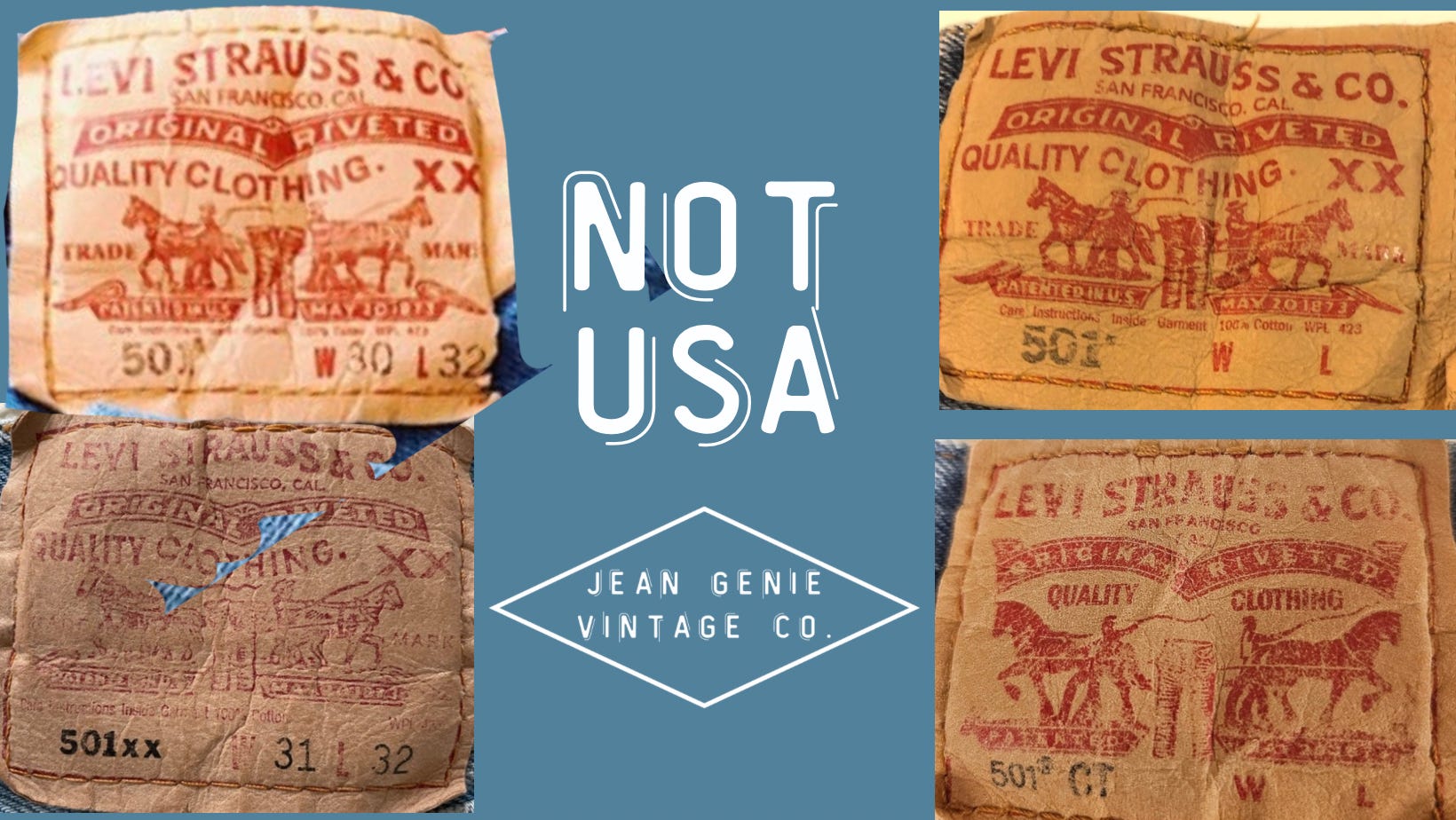
Plain and simple — for a 501: If the words Made in the USA aren’t there, you’re not looking at the real deal. But how do you know?
Stay with me…
501s: The OG denim jean. Straight leg, Button fly. Bigger back panel than front panel — which gives that hugged bum effect.
The easiest to authenticate. Yay!
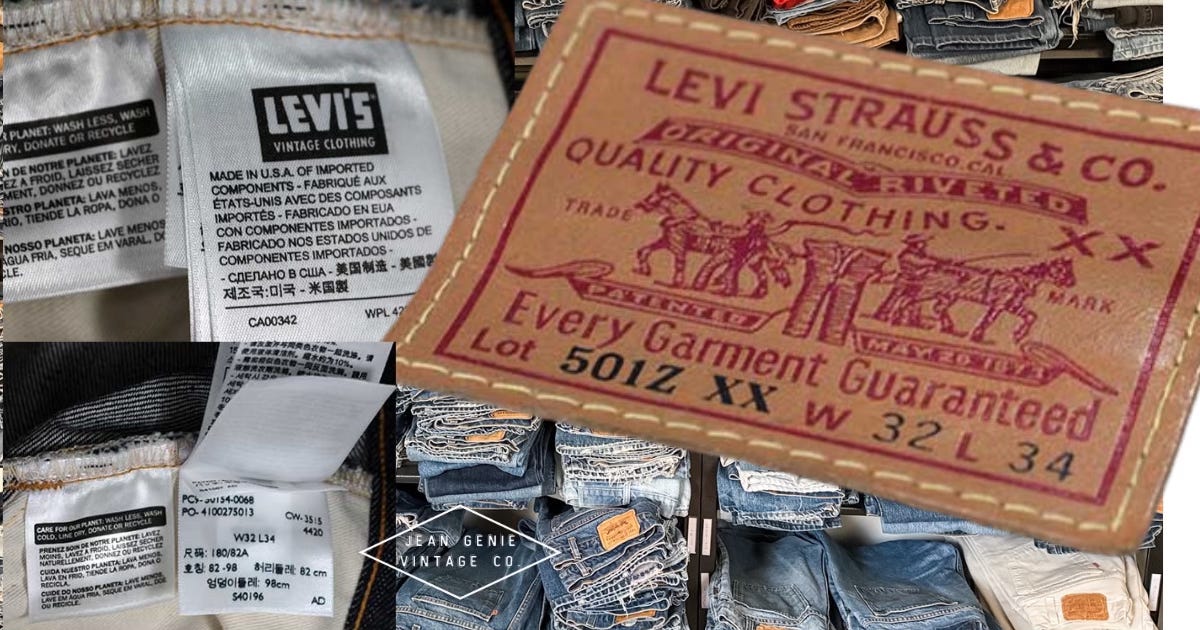
If a pair of 501 is truly vintage, it will say Made in the USA in two places:
On the back leather patch
On the inside size tag — which can be found inside the right hip if you are looking at them (and inside the left hip if you’re wearing them).
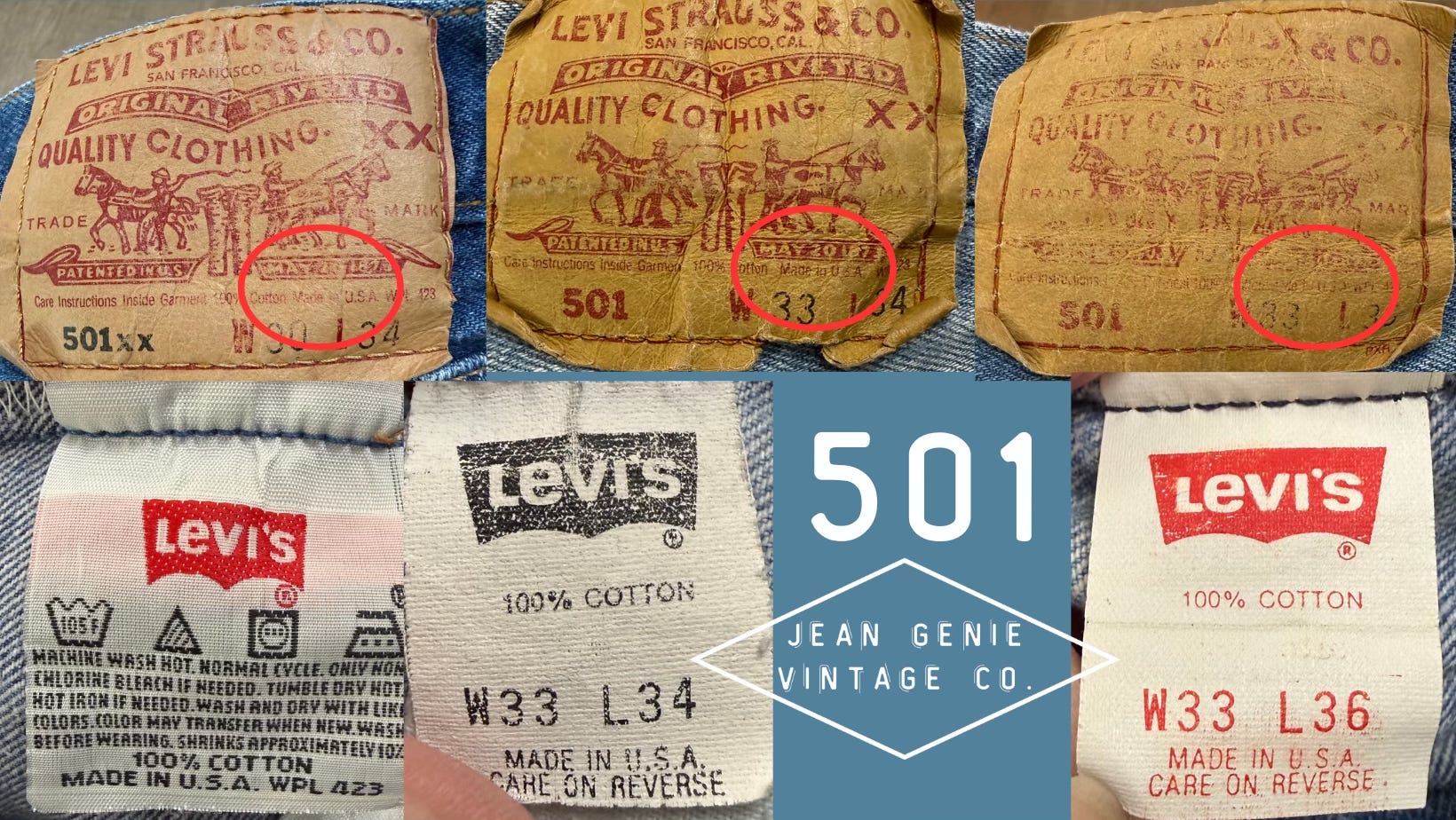
If it doesn’t say it in both places (or at least on the tag inside if the leather patch is gone, then I’d keep moving.)
Note (on repeat to drill into your brain): a 501 will ALWAYS say made in the USA on the back leather patch if it is truly made in America. (reason I say this is because other Levi’s styles don’t follow this rule — because that would make it allll too easy. le sigh.)
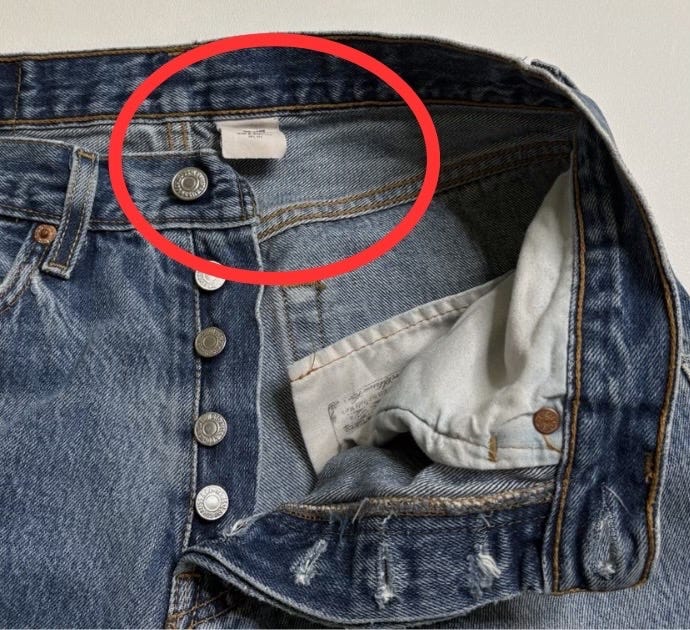
Below is a tell-tell sign that a 501 is NOT made in USA. ALL Made in USA 501 will have the size tag inside the left hip. MANY non-USA 501S have this tag in the back of the waist band (as shown below).
505s and 517s: Both zip fly. Many are orange tabs, many are red tabs. Both have equal front and back panels for a more tailored look.
505s: Straight leg. Similar leg to the 501, but slimmer cut through the hips.
517s: Bootcut. Slimmer cut through the hips — similar to a 505 up top.
Now as for investigating the origin of manufacture… These are a little trickier.
Up until about 1993–1994, the leather patch on the back did show Made in the USA.
After that, Levi’s removed it from the patch—but it still appears on the inside size tag.
So if you’re checking a pair of vintage 505s or 517s, the inside tag is where the truth lives.
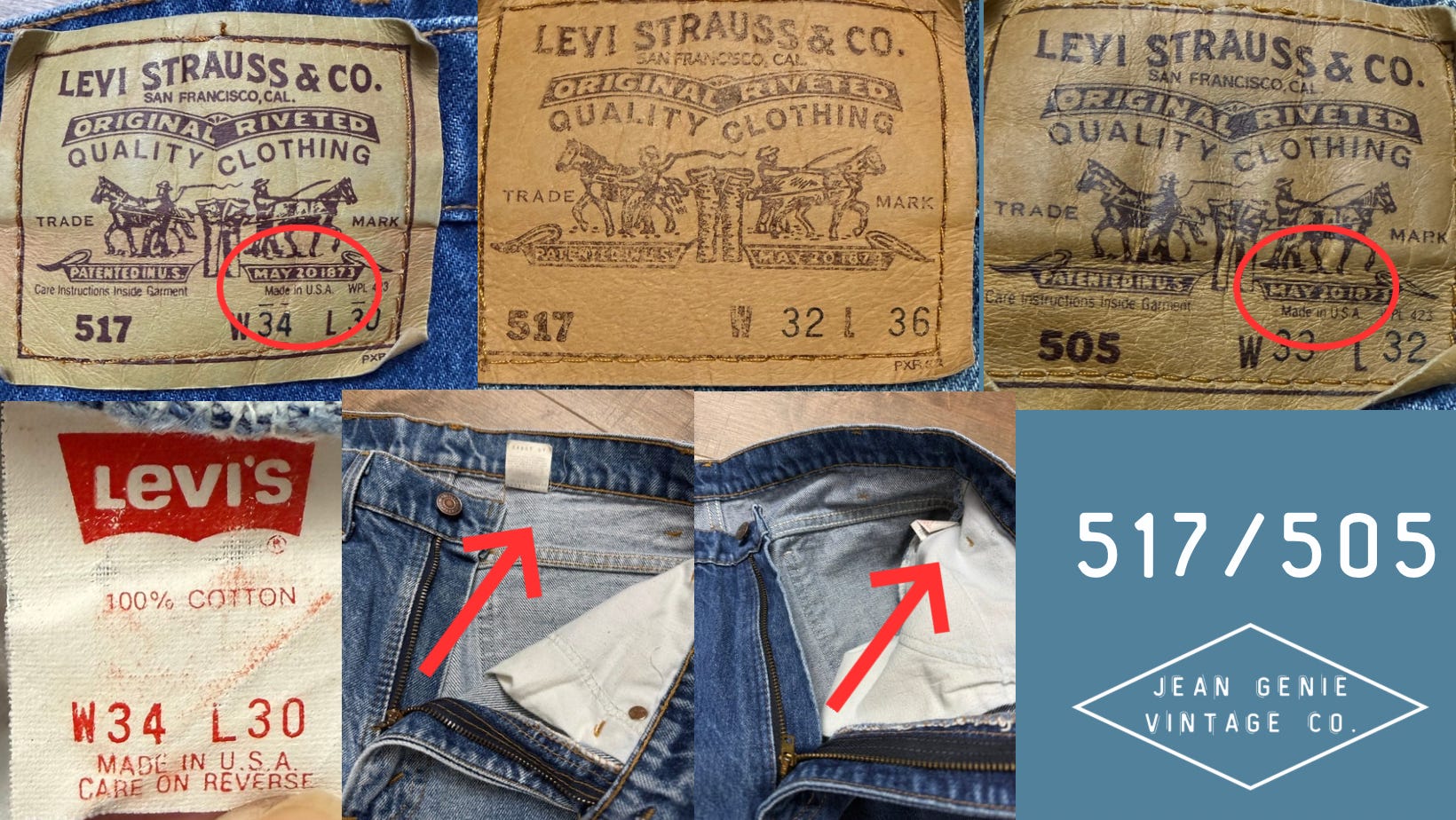
In the photo above, you can see how 2 of the leather patches say “Made in USA” and one doesn’t. Yet, ALL are indeed USA made.
In 1994, Levi’s stopped putting “Made in USA” on the leather patches on 505 and 517. Why?
No — I’m really asking… WHY?!?!?
So… in regards to the 32x 36 517 in the photo above — that doesn’t say USA on the leather tag — the inside tag DOES say Made in USA. This is how it goes for all 505 and 517. Also, the tags inside vary from inside the left hip in older pairs to in the upper waist band for pairs from about 1994 and newer. (eye roll.)
Consistently inconsistent.
Take home: You have to go off the tag inside if you are trying to determine if USA or not.
646s and 684s: These are the legendary flares and bell bottoms respectively.
Both 646s and 684s stopped being produced in 1983, which means every authentic pair was made in the United States.
No exceptions.
Original 1970s Levi’s 646 and 684 jeans typically did not have leather patches on the back, so you have to rely on the inside tag. They had paper tags held on by white thread, of which you can sometimes see the remnants on the denim decades later.
Back to inside tags… many of these tags are far to faded to see any of the numbers. That said, if you see a little tiny white paper tag inside the right hip, you’ll know it was made in USA.
Levi’s did make a few runs of reproductions of 646 and 684 in the late 80s into early 90s, but those will have a different (more modern) tag inside — but will still say made in the USA and ARE considered vintage. Just not as valuable or rare as the originals.
I will add one final layer to the confusion. L V C
Levi’s launched a line — the LVC line, or Levi’s Vintage Clothing (LVC) — in 1996 that reproduces iconic, archival pieces from Levi Strauss & Co’s denim lineup of yesteryear. LVC is a premium, high-quality reproduction line using archival details, while true vintage Levi’s are original, aged, and worn items from past decades. LVC denim has man-made fades, whereas vintage offers broken-in denim with historical patina.
The Vintage vs. Used Problem
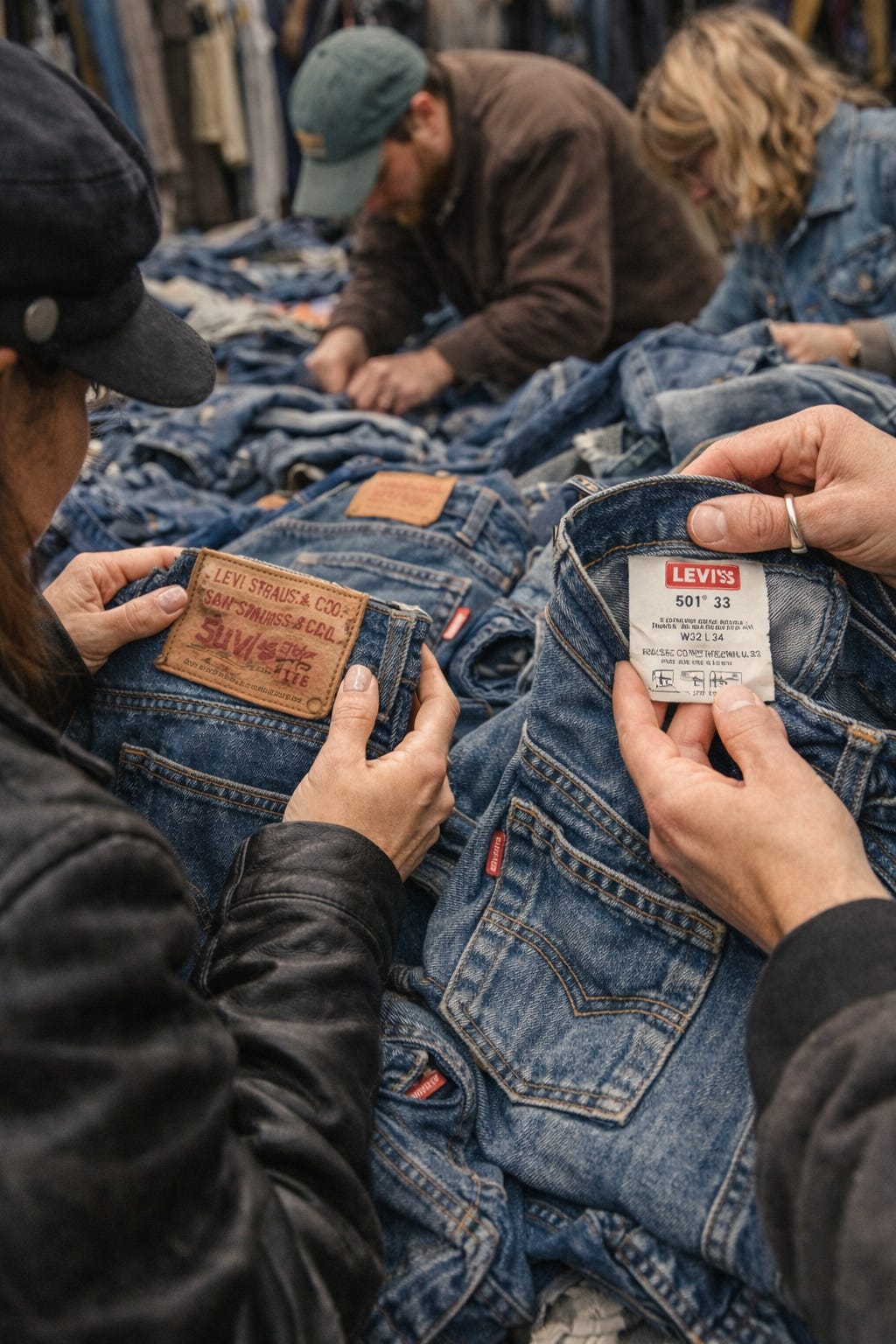
There are many sellers out there claiming to offer vintage Levi’s — online and in stores.
Some absolutely are vintage. Others (many)… are not.
I like to think that the misrepresentation is not intentional — simply a lack of knowledge. But who really knows?
But the result is the same: people pay vintage prices for what are essentially used jeans.
And those are two very different things when it comes to value.
Vintage Levi’s — the true, American-made pairs — are becoming increasingly hard to find, which is why the investment has also risen in recent years. But if you find a reputable seller — who has done the research to curate a collection of pairs that fit the criteria (cough, cough — me) — then you can purchase with confidence.
If you’re unfamiliar with a seller, now you’ll have the tools to know if their offerings are worth spending your money on.
ALL that said… If it doesn’t matter to you if your Levi’s are truly vintage — that is A-OK!
Maybe you stumbled upon a pair of old jeans and fell for the fades, the fit, the way they feel like they’ve already lived a life before you. Great! Truly. If you love them and you’re going to wear them, that’s what matters most. Giving any pair of jeans a long, well-worn second act is about as sustainable as it gets.
My mission here isn’t to shame anyone for loving a pair of old jeans. It’s simply to give people the tools to tell the difference — so they can sift through the sea of blue with a little more confidence about what they are buying.
The Two-Step Litmus Test
If you’ve jumped ahead like someone hunting for the recipe in a long-winded Pinterest food blog, I see you. No judgement.
If you remember nothing else from this article, remember this simple two-step reality check:
They must be at least 20 years old to be considered vintage.
True vintage Levi’s will be Made in the USA — which means they will without a doubt be at least 24 years old, since Levi’s stopped U.S. production in 2002.
If they don’t check those boxes, they’re not vintage — just used.
And to be clear, there is absolutely nothing wrong with used jeans. But they shouldn’t cost you vintage prices.
Would love to hear your thoughts? Helpful? Want more articles like this one? Leave a comment below!
Forever in blue jeans,
XO Meg
LOOSE THREADS: Pull here for more…
To learn more about me, Meg, and how Jean Genie Vintage came to be — you can read more in “Confessions of a Jean Genie”.
If you need help with sizing — since vintage Levi’s sizing is also notorious for it’s inconsistencies — you can read my article that will help you "Detach from the Tag”.
I invite you to check out my online shop: Jean Genie Vintage — a curated online vintage denim destination — built on a decade of sourcing, studying, and wearing vintage Levi’s, with clear-eyed advice on fit, quality, and value.
I keep re-reading this as it is so educational. I wish it came in a foldable print out. ha.
I really learned a lot from this Meg - thank you for all the research and love you put into the Levi's you sell. I always feel confident buying from you. X